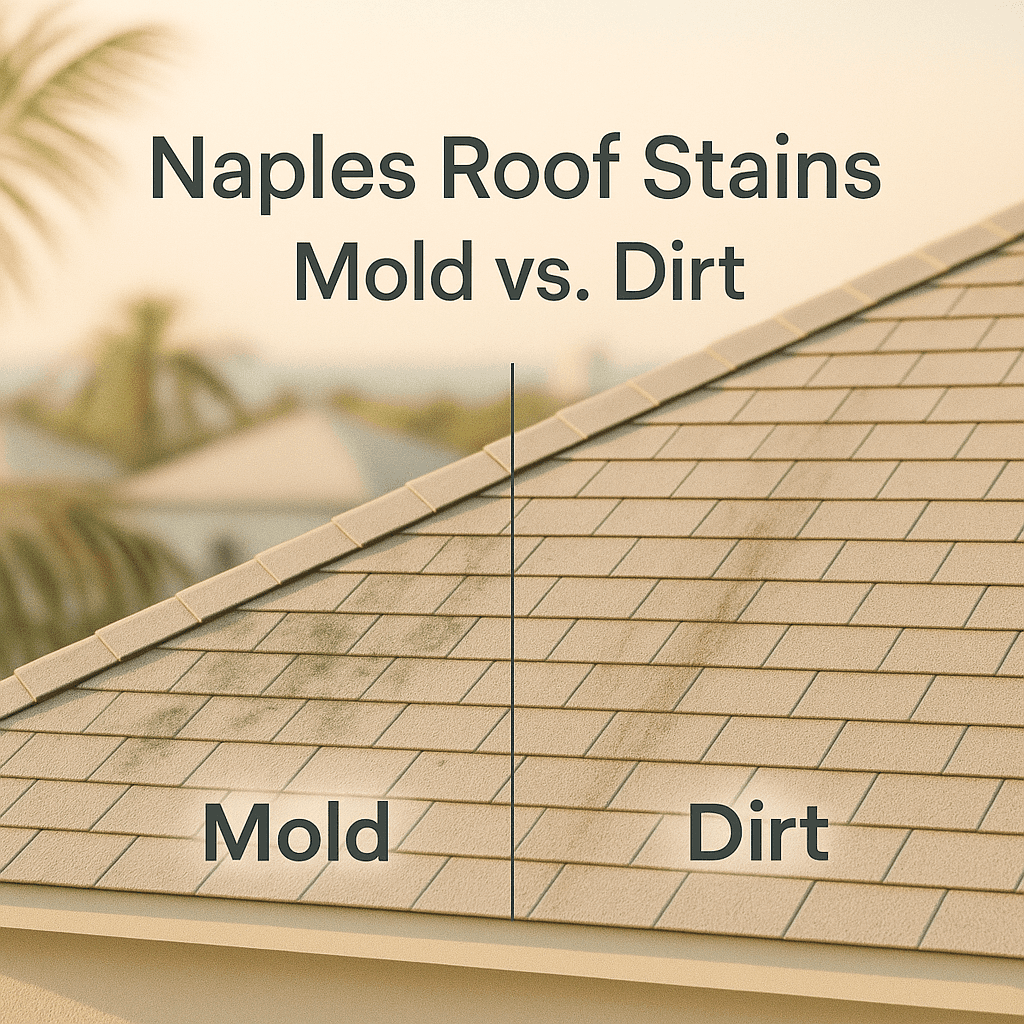
If you live in Naples long enough, you start to notice the same thing on a lot of roofs. A little dark shading near the ridges. Streaks that look like someone dragged a wet broom down the shingles. Random blotches that weren’t there last season, and now they kind of… are.
And the confusing part is this. Not every stain is the same problem.
Some stains are just dirt. Some are organic growth. Some are a mix. And in Southwest Florida, where humidity is basically a permanent roommate, roof stains can change fast. Like, you blink and the roof looks older than it is.
This is the guide I wish every homeowner had before they either ignore it for two years or climb up there with a pressure washer and make it worse.
So let’s sort it out. Mold vs dirt. What it looks like, what it means, and what you should actually do next.
Why roof stains are so common in Naples (it’s not just “being dirty”)
Naples has a perfect recipe for roof staining.
Warm temperatures most of the year. Heavy rain cycles. Shade from palms and mature landscaping. Salt in the air near the coast. And long stretches where the roof stays slightly damp in the morning, even if it doesn’t rain.
That moisture window is the whole game. If a roof stays damp just a bit longer than usual, organic growth gets comfortable. If the roof is in full sun all day, stains still happen, but usually slower.
Also. Roof pitch matters. Roof material matters. Even the direction your home faces matters.
In other words, if your neighbor’s roof looks clean and yours doesn’t, it doesn’t automatically mean your roof is “worse.” It might just be the micro conditions. Shade, airflow, trees, all that.
First, the quick truth: “Mold” on roofs is often not what people think
Homeowners say “mold” as a catch all. Totally normal.
But on roofs, the most common culprit behind those black streaks is often algae, specifically the stuff called Gloeocapsa magma. It’s an airborne algae that thrives in warm, humid climates. Sound familiar.
Mold and mildew can show up too, especially in shaded areas or where debris sits and holds moisture. But those long black streaks? Frequently algae.
Still, from the curb, algae vs mold vs dirt can all look the same. So you have to go by patterns, texture, location, and how it behaves after rain.
What dirt stains look like (and how they usually show up)
Dirt on a roof is usually boring. In a good way.
It tends to look like:
- Brown or gray dusty film
- Light staining that’s more even than streaky
- Accumulation in valleys, behind chimneys, near skylights
- A “dirty gradient” where runoff carries grime down to one area
Dirt staining often comes from:
- Windblown sand and dust
- Pollen season (Naples gets that yellow haze, you know it)
- Construction in the area
- Traffic and air particulates
- Debris breaking down (leaves, seed pods, palm fronds)
A big clue is that dirt tends to sit where water slows down or where the roof “catches” stuff. Valleys, edges, transitions.
And dirt usually looks lighter when the roof is wet, then reappears as it dries. Organic staining can do that too, but dirt often has that flat dusty look.
However, if you’re unsure whether that black stuff on your roof is just dirt or if it’s something more serious like mold or algae, you might want to check out this discussion for some insights from other homeowners who have faced similar situations.
What mold or mildew staining looks like (not always streaks)
Mold and mildew on roofs can look like:
- Dark blotchy spots, sometimes with fuzzy edges
- Patches that cluster in shaded areas
- Staining around places that stay damp longer (under trees, north facing slopes)
- Growth near roof penetrations or areas where water doesn’t drain cleanly
Mildew can sometimes look like a smudgy gray film. Mold can look darker and more “alive,” for lack of a better word. Like it has shape. Not just dust.
Another clue. Mold and mildew often show up with other signs nearby, like:
- Blackening on soffits or fascia in the same shaded area
- Musty smell in the attic (not always, but it happens)
- Gutter gunk and organic sludge that keeps coming back quickly
But again, in Naples, what people call mold is often algae. Which brings us to the streaks.
What algae stains look like (the classic black streaks)
If you see:
- Long, dark streaks running down from the ridge
- Streaks that follow the slope line
- Darkening that starts high and “drips” downward over time
That’s usually algae. This type of staining tends to start as light discoloration. Then it deepens. Then it becomes obvious from the street. It also spreads slowly across the roof surface because it’s airborne and it reproduces in those damp conditions.
A lot of homeowners notice it after a rainy season, or after a summer where the roof stays wetter longer. And Naples summers definitely qualify.
Also worth noting. Some asphalt shingles have limestone filler that algae likes. So once it gets established, it feeds and holds.
For more detailed insights into what causes roof stains, this resource provides valuable information. Additionally, if you’re interested in understanding more about roof black algae, there’s comprehensive information available on that topic as well.
The “spray test” and other stuff you shouldn’t do (but people do)
I get why people try DIY tests. You want certainty.
But a few common moves can go sideways:
- Spraying bleach from a ladder. Dangerous and usually uneven. Plus runoff can affect landscaping.
- Pressure washing the roof. This can strip granules, shorten roof life, and void warranties on some materials.
- Scrubbing with a broom. Same problem. Abrasion. Granule loss.
- Ignoring it because “it’s just cosmetic.” Sometimes it is. Sometimes it is not. And the roof doesn’t exactly send you a text when the problem changes.
If you want a safe, low effort clue without touching the roof, here are better “tests”:
1) Look at where the staining is worst
- Worst under trees or on shaded slopes: more likely organic growth.
- Worst in valleys and low points: could be dirt and debris, or organic growth feeding on debris.
- Worst near ridge and evenly streaking downward: often algae.
2) Track how quickly it’s spreading
- Dirt buildup tends to be slow and seasonal.
- Algae and mildew can accelerate once established. If you’re dealing with such issues, there are methods to remove algae and mold from your roof that can be much safer than DIY tests.
3) Check for debris “beds”
If you see piles of leaves, palm fragments, seed pods, that’s a moisture sponge. Organic growth loves that. Even if the stain started as dirt.
Does it matter if it’s mold vs dirt?
Yes. Because the fix is different.
If it’s mainly dirt, a gentle rinse and proper exterior washing might solve most of it, especially if the roof is otherwise clean and the main issue is surrounding areas like gutters, soffits, and walls.
However, if it’s algae, mold, or mildew, you need a cleaning method that kills and removes organic growth without damaging the roof. That’s where soft washing comes in.
Soft washing is basically low pressure application with roof safe cleaning solutions, followed by a controlled rinse. The goal is to treat the organism, not blast the roof.
Also, organic growth can hold moisture against the roof surface. Over time, that can contribute to deterioration, especially if debris is involved or if water is not draining correctly. It’s crucial to address this issue promptly. For more information on effective cleaning methods for various surfaces in your home, including when and how to clean and disinfect your home properly, you can refer to this CDC guide.
So yes. It’s not just aesthetics.
A simple Naples specific checklist to help you identify the stain
If you want the quick breakdown, use this:
It’s probably dirt if:
- Color is tan, light gray, dusty
- Staining is heaviest in valleys and corners
- You’re near construction or high traffic areas
- It looks like an even film, not streaks
It’s probably algae if:
- Dark streaks start near ridge and run downward
- The roof looks “striped” from the street
- It’s spreading gradually over the field of shingles
- Your neighbors have similar streaking (common in the same microclimate)
It’s more likely mold or mildew if:
- You see blotchy patches in shaded areas
- The staining clusters around debris buildup
- It returns fast after rain seasons
- There’s visible growth on nearby exterior surfaces too
And just to complicate things slightly. A roof can have all three.
Dirt sticks to organic films. Algae grows where dirt and moisture collect. Mildew grows where algae keeps things damp. It stacks.
What you should do (and what you should not do) if you see staining
Here’s the realistic playbook.
- Don’t pressure wash the roof. If you take nothing else from this, take that.
- Trim back overhanging branches if they keep sections shaded and drop debris.
- Clean gutters so water doesn’t overflow and create постоян wet zones along edges.
- Schedule a professional soft wash if the staining is dark, spreading, or clearly organic.
If you’re in Naples, Bonita Springs, or Marco Island, this is exactly what Naples Pressure Washing & Roof Cleaning does all day. Soft wash roof cleaning designed for Florida roofs, with the right mix, the right dwell time, and no aggressive pressure. You can request a quote here: https://naples-pressure-washing.com/
A quick note about roof type (because it changes everything)
Different roofs stain differently.
- Asphalt shingles: algae streaks are very common. Soft washing is typically the go to.
- Tile roofs (barrel tile, concrete, clay): you might see dark spotting, lichen like growth, and heavier debris lodging. Tile can handle different approaches, but pressure still needs to be controlled and used correctly. A lot of damage happens on tile roofs from improper cleaning.
- Metal roofs: often show mildew and grime patterns, especially on shaded sides. Oxidation can be confused with staining sometimes.
So if you’re not sure what you’re looking at, it’s not a “dumb question.” Roof staining is weirdly technical once you get into it.
How often should Naples roofs be cleaned?
There’s no single schedule. But in this climate, many homeowners land somewhere around every 1 to 3 years, depending on:
- tree cover
- roof orientation
- how close you are to the coast
- how visible staining becomes
- HOA expectations (some HOAs are strict, some are not)
If you wait until the roof looks almost black from the street, it’s still cleanable in many cases, but you’re making it harder on yourself. Earlier cleaning is usually easier, faster, and more consistent in results.
Wrap up (the simple way to think about it)
If the stain looks like dust or mud and sits in low spots, you’re probably dealing with dirt.
If it’s blotchy and concentrated in shade, it might be mold or mildew, or organic growth feeding on debris.
If it’s dark streaks running down from the ridge, that’s often algae. Naples classic.
And whatever it is, the best next step is usually not a ladder and a pressure washer. It’s getting the roof evaluated and cleaned with the right method so you’re not trading stains for roof damage.
If you want someone local to take a look and give you a straightforward recommendation, you can reach out to Naples Pressure Washing & Roof Cleaning here: https://naples-pressure-washing.com/
FAQs (Frequently Asked Questions)
Why are roof stains so common in Naples, Florida?
Roof stains are common in Naples due to the perfect combination of warm temperatures, heavy rain cycles, shade from palms and mature landscaping, salt in the coastal air, and long periods where roofs stay damp in the morning. This moisture encourages organic growth like algae and mold on roofs.
What is the most common cause of black streaks on roofs in Southwest Florida?
The most common cause of black streaks on roofs in Southwest Florida is airborne algae called Gloeocapsa magma. This algae thrives in warm, humid climates and creates those distinctive dark streaks running down from the roof ridge.
How can I tell if roof stains are just dirt or something more serious like mold or algae?
Dirt stains usually appear as brown or gray dusty films with light, even staining often accumulating in valleys or behind chimneys. Mold and mildew tend to form dark blotchy spots with fuzzy edges, often in shaded areas that stay damp longer. Algae stains typically show as long dark streaks following the roof slope lines. Observing patterns, texture, location, and behavior after rain can help differentiate them.
Does the direction my house faces affect roof staining?
Yes, micro conditions such as roof pitch, material, shade from trees, airflow, and even the direction your home faces can influence how quickly and severely roof stains develop. Different exposures to sun and moisture create varying conditions for organic growth.
Is it safe to clean roof stains myself using a pressure washer?
Using a pressure washer on your roof can often make staining worse by damaging shingles or spreading spores further. It’s recommended to understand what kind of stain you have first—dirt, mold, or algae—and then use appropriate cleaning methods advised by professionals to avoid damage.
What signs indicate mold or mildew presence beyond visible stains on my roof?
Besides dark blotchy spots on shaded areas of your roof, signs of mold or mildew include blackening on soffits or fascia nearby, a musty smell in the attic (though not always present), and recurring organic sludge buildup in gutters. These clues suggest persistent moisture issues encouraging mold growth.

