Soft Wash Roof Cleaning
How the method works, from inspection to final rinse
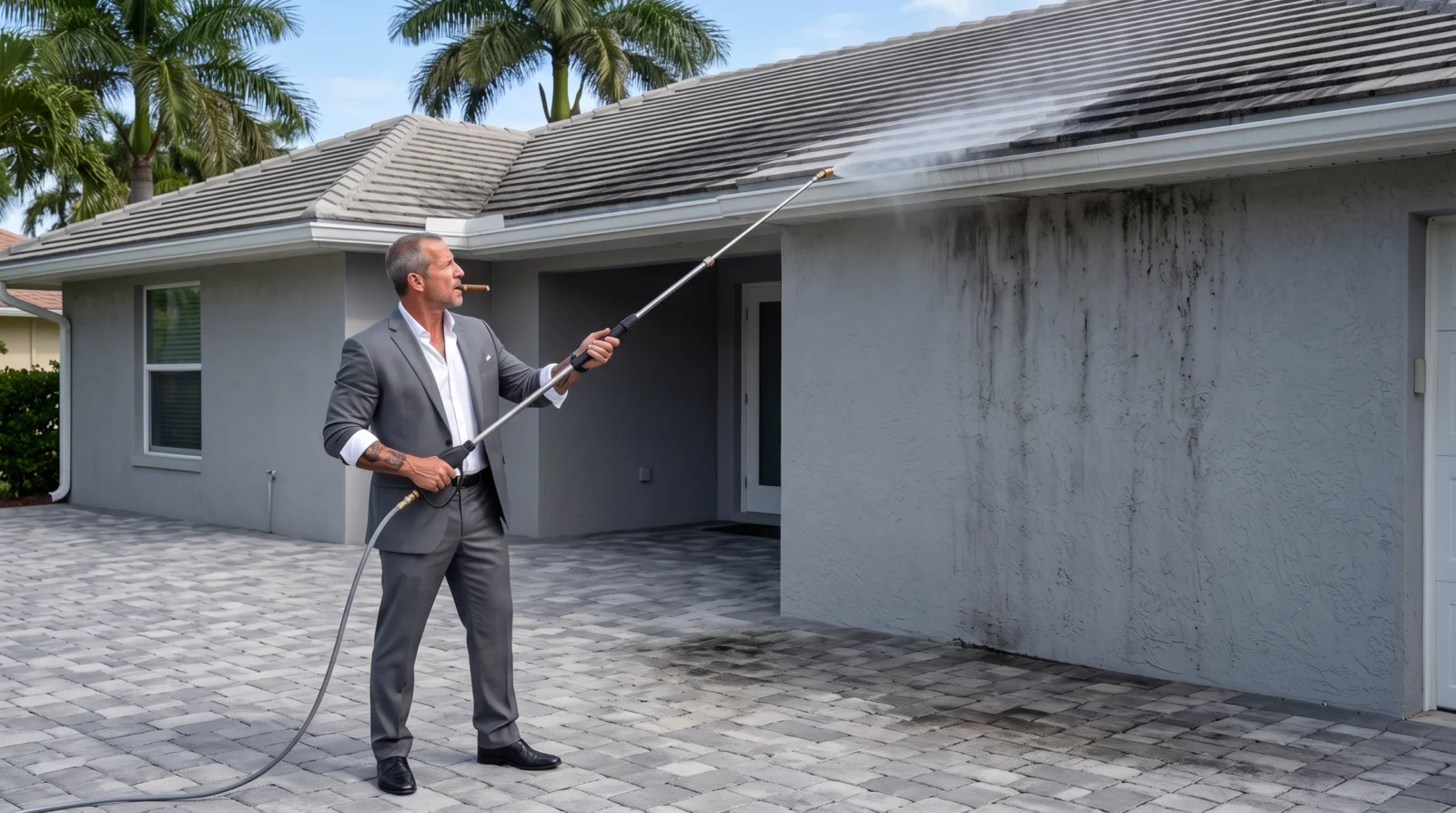
Soft washing cleans a roof with chemistry and time instead of force. Below is exactly what our crews do on a Naples roof, why each step exists, and what can go wrong when a step is skipped.
📞 Free Quote — 239-544-1165the nozzle
the cleaning
roof
Why does soft washing work better than force on a roof?

A stained roof is covered in living organisms: algae, mold, mildew and lichen. Force can tear the visible part away, but it leaves roots in the pores of tile and the texture of shingles, and it damages the roof in the process. Soft washing kills the organisms where they grow, lets the dead material loosen, and then rinses it off gently. The cleaning agent does the work that pressure would otherwise do. The result is a roof that is clean down into its surface, without the erosion, cracked tiles and stripped granules that high pressure leaves behind.
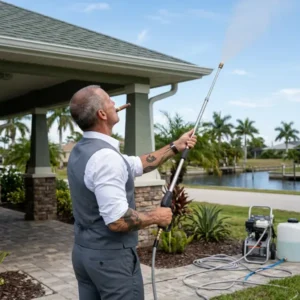
Step 1: Inspect the roof before anything is mixed
Every job starts on the ground with a walk around the house and, where it is safe, a look at the roof itself. The crew notes the roofing material, the pitch, the condition of the tiles or shingles, and the type of staining. Black streaks from algae, green mold under trees, crusty lichen and rust from flashing each respond differently.
We also look for things that change the plan. Cracked or slipped tiles get photographed and pointed out before cleaning, so there is no question later about when they happened. Loose ridge caps, exposed underlayment, soft spots on shingle roofs and damaged flashing are noted too. If a roof is in poor enough condition that cleaning would cause more harm than good, we will say so.
Finally we look at what is below the roof: the beds along the drip line, the downspout outlets, the pool and screen enclosure, vehicles, outdoor furniture and anything electrical. That determines how the protection step is set up.
Step 2: Protect plants, pool, gutters and fixtures
Plants along the foundation are soaked with clean water. Saturated leaves and soil absorb far less of the solution than dry ones. Tender plants directly under a downspout can be covered for the duration. Outdoor lights, exterior outlets and pool equipment are protected from runoff. Surrounding landscaping, pool areas and AC equipment are protected throughout the cleaning process.
Gutters and downspouts get special attention because they concentrate everything that runs off the roof into a few points. If the gutters are clogged, they are cleared first, since an overflowing gutter sheets solution down the walls. Downspouts that empty into planting beds are flushed with clean water during the job.
For homes with a pool cage, runoff will land on the screen roof and drain onto the deck. The cage is wetted before work begins and rinsed as the roof is treated, and debris is kept out of the pool water.
Step 3: Mix the solution for this roof
The cleaning agent is sodium hypochlorite, the active ingredient in bleach, delivered at a higher concentration and diluted on site. A surfactant is added so the mix clings to the slope long enough to work instead of running straight to the gutter.
How strong the mix is depends on the roof. Porous concrete tile with years of growth needs a stronger mix than a lightly stained shingle roof. Clay tile, metal roofing and membrane roofs each have their own limits. Metal flashing, copper accents and painted metal can discolor if they sit under strong solution, so they are wetted and rinsed with extra care.
We do not use a single strength for every roof. Overly strong solution increases the risk to landscaping and metal, and an overly weak mix just leaves the roof half cleaned and the customer calling back.
Step 4: Apply with low pressure and let it dwell
The solution is applied through equipment designed for low-pressure delivery. On many roofs it can be applied from the ground or the roof edge, which reduces foot traffic on the tile. Where the crew must walk the roof, they step on the strongest part of each tile and avoid the unsupported edges. Careless tile walking causes cracked tiles, dislodged barrel tile and broken mortar on Naples homes, all expensive repairs that trained foot placement and low pressure avoid.
Coverage is even and complete, starting where the growth is heaviest. The solution is then left to dwell. During that time you can watch the black streaks turn lighter and then fade. On hot afternoons in Naples the solution can dry on the roof before it finishes working, so the crew keeps it wet, works in sections, and avoids the hottest part of the day when possible. When the organism is killed completely rather than just surface-blasted away, regrowth is dramatically slower.
Areas that remain stained after the first pass, often heavy lichen or deeply rooted algae on the shaded side, get a second application rather than more pressure.
Step 5: Rinse low and slow
Once the solution has done its work, the roof is rinsed at low pressure with plain water. The rinse clears loosened growth and residual solution from the surface, the gutters and the downspouts. Then the crew turns to the ground: walls that caught runoff, windows below the eaves, the pool deck and screen, and the planting beds all get rinsed again.
Lichen and heavy algae do not always come off completely on day one. The dead material keeps loosening and washes away over the next rains. We tell you at the end of the job what to expect, and if any area still looks treated but not clean after a reasonable stretch of weather, we come back and look.
Step 6: Walk the job and leave a record
The finished roof is checked from the ground and, where it is safe, from the roof. Any damage noted in step 1 is reconfirmed. The yard is put back the way it was found. You receive a written note of what was cleaned and anything the crew observed, such as cracked tiles, failing mortar on ridge caps or gutters that are pulling away. That record is useful for your own files, for an association that asked you to clean the roof, and for a buyer if you sell.
What changes for each roof type?
- Concrete tile: the most porous common roof, so it takes the most dwell time. Mortar on ridge and hip caps is fragile and is never sprayed hard; it gets its own gentle treatment.
- Clay tile: harder but brittle. Glazed clay is not scrubbed. Foot traffic is kept to a minimum.
- Asphalt shingle: a milder mix, careful rinsing and no pressure at all on the granules. See our shingle roof cleaning page.
- Metal: growth is usually lighter. The main concern is protecting painted finishes and fasteners and working safely on a slick surface.
- Flat and membrane roofs: water ponds and algae spreads fast. The membrane must not be scarred, and drains must stay clear.
How do weather and timing affect a soft wash?
Southwest Florida weather shapes the schedule more than most homeowners expect. Heat is the first factor. On a hot, sunny roof the solution evaporates quickly, which shortens the time it has to work and concentrates it as it dries. Crews prefer mornings or overcast stretches, and they work the sunny slopes in smaller sections so each one can be kept wet and rinsed on time.
Wind is the second. A gusty day carries spray off the roof and onto plants, cars and neighbors’ property. Low-pressure application already produces large droplets rather than mist, but on a windy afternoon the crew changes the order of work or reschedules.
Rain is less of a problem than people think. A shower before the job just means the roof starts wet. A shower after the solution has worked and the roof has been rinsed does no harm and often helps carry away leftover dead growth. What we avoid is heavy rain in the middle of the dwell, which washes the solution off before it finishes and sends it into the beds less diluted than we would like. In the summer rainy season that usually means starting early and finishing before the afternoon storms build.
How is the crew kept safe on your roof?
Roof work is the most dangerous part of exterior cleaning. Tile is slick when wet, metal even more so, and a soft wash solution makes every surface slicker. Our first preference is to apply and rinse from the ground or from a ladder at the eave whenever the roof shape allows, which is safer for the crew and easier on the tile.
When someone must go onto the roof, they use footwear made for roofing surfaces and fall protection appropriate to the pitch and height, and they plan their path before stepping off the ladder. Ladders are set on firm ground, tied off where possible and kept clear of power lines. Two-story and steep roofs take more setup time, which is one reason they are priced higher than single-story roofs.
For homeowners, the advice is simple. Do not try to walk a wet tile roof to inspect the results. If you want a closer look after cleaning, ask the crew to photograph the areas you care about.
What will you notice during and after the job?
During the visit you will see the roof darken briefly where the solution goes on, then the streaks fade within minutes. You may notice a mild chlorine smell near the house; it dissipates after the rinse. Water will run from the downspouts for a while, and the crew will be rinsing beds and walls throughout.
Over the following days, especially after rain, the roof usually continues to brighten as dead growth releases. Lichen patches can take the longest; they turn pale and then flake away. If a patch is still clearly attached after a few weeks of normal weather, let us know.
When is soft washing the wrong call?
Soft washing cleans a roof; it does not repair it. A roof with many broken tiles, delaminating shingles or failing underlayment needs a roofer, and cleaning may just make the damage easier to see. A roof that is near the end of its life may not be worth cleaning if it is about to be replaced.
Rust stains from metal are another limit. They need a rust remover, not chlorine. And on very steep or very high roofs, access and safety equipment may change the approach and the price. When any of these apply, we explain the options before quoting.
For pricing and roof types, see our main roof cleaning page. Starting prices are single-story from $299, two-story from $399 and large estate roofs from $499.
Frequently Asked Questions
How long does the solution stay on the roof?
Is the solution the same as household bleach?
Can you clean the roof without walking on it?
Why are some streaks still faintly visible after cleaning?
Will soft washing remove rust stains on my roof?
Is it safe to soft wash in the rainy season?
About the Author

Owner Blane Perun started this company with a simple premise: Naples homeowners deserve a professional exterior cleaning option that doesn’t come with the inflated pricing of franchise operations and large corporate companies.