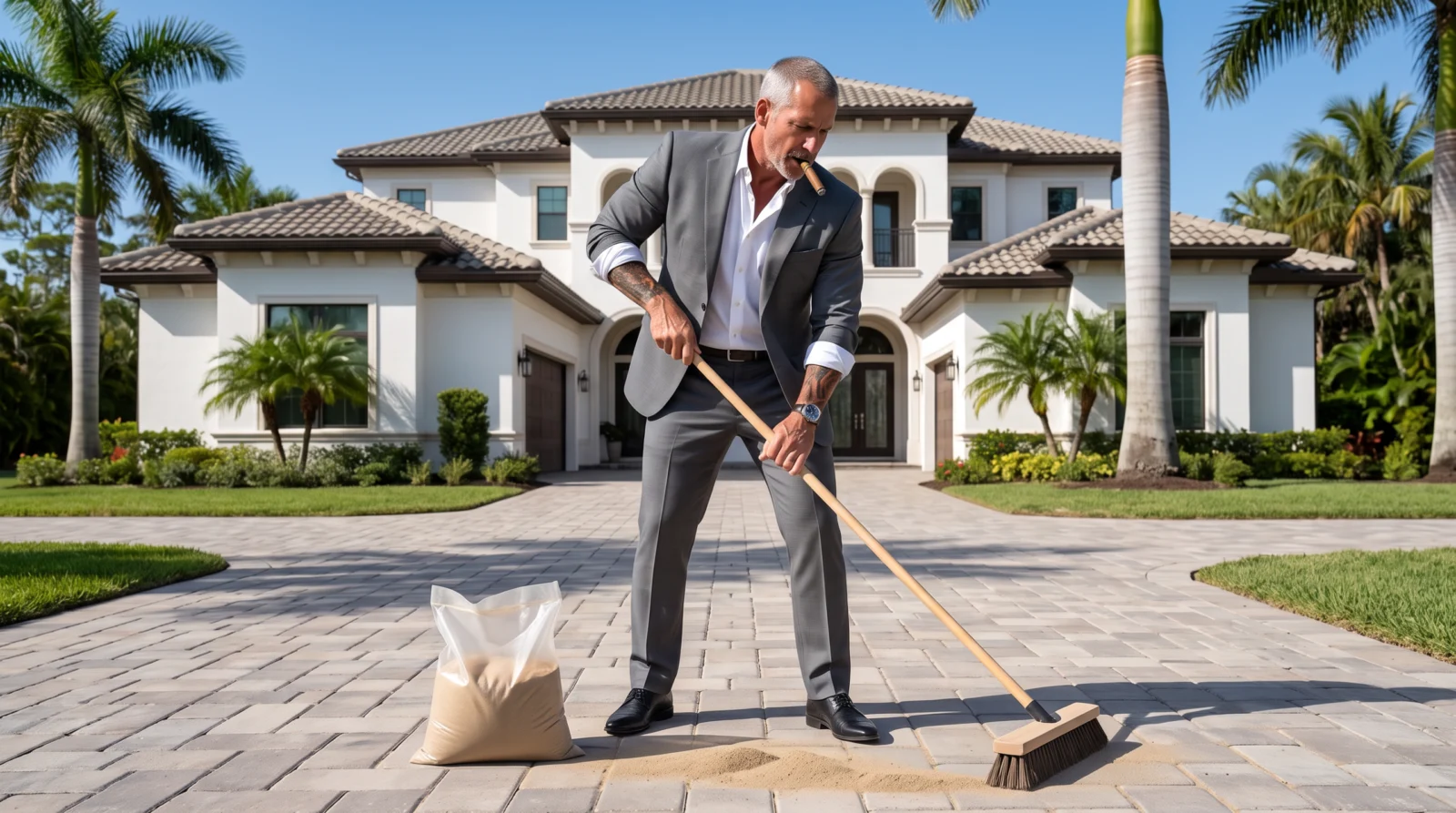
Paver Sanding & Joint Repair
The sand between your pavers does more than you think
Joint sand keeps pavers locked together and keeps weeds and ants out. In Southwest Florida rain, irrigation and cleaning wash it away steadily. This page explains how joints are refilled, the difference between sand types, and how to avoid the common mistakes.
📞 Free Quote — 239-544-1165to 400 sq ft
re-sand
seal 400 sq ft
What does joint sand actually do?

A paver surface works as a system. The pavers sit on a compacted base and a thin bedding layer, edge restraints hold the perimeter, and the sand in the joints locks the units together. When a car drives across one paver, the joint sand transfers part of the load to its neighbors. That interlock is what lets a paver driveway carry vehicles without individual pavers sinking or tilting. Re-sanding is one of the most frequently skipped maintenance steps for Naples paver driveways, patios, pool decks and walkways.
Joint sand also fills the space where weeds and grass would otherwise root, and it makes tunneling harder for ants. And because it is permeable, it lets some water drain through the surface rather than sheeting off.
When joints empty, pavers start to move. They rock, edges chip against each other, patterns drift, low spots form and hold water, and weeds arrive quickly. Keeping the joints full is cheap maintenance compared with resetting a section of pavers.



Why does joint sand disappear in Naples?
Several forces work on joint sand at once here. Heavy summer downpours wash loose sand out of the joints, especially on sloped driveways and at downspout outlets. Sprinklers do the same on a daily basis along lawn edges. Ants excavate joints and carry the sand to the surface, where it is swept or rinsed away. Leaf blowers move dry sand. And pressure washing, whether by a homeowner or a contractor, removes a significant amount every time the pavers are cleaned.
You can see the result as joints that look lower than the paver edges, dark gaps where you can see down toward the bedding layer, sand piles on the surface from ants, and weeds following the joint lines.
Regular sand or polymeric sand?
Regular joint sand is a fine, dry sand swept into the joints and compacted. It is inexpensive and easy to top up, and it is what many pavers were originally installed with. Its weakness in Florida is that it stays loose, so rain, ants and cleaning remove it steadily. In Naples’ climate, kiln-dried sand in exposed paver joints is essentially a temporary fix.
Polymeric sand is a graded sand blended with binders that activate when wetted. After it is swept in, compacted and misted with water, it cures into a firm, flexible joint that resists washout, discourages weeds and is harder for ants to tunnel through. It costs more and has to be installed correctly, but on most Naples driveways and pool decks it lasts much longer than regular sand. The additional cost of polymeric sand over kiln-dried sand is modest, but the difference in longevity and performance in Naples is dramatic.
There are also differences among polymeric products: joint width limits, colors, curing times and how much rain they tolerate early in the cure. The product is chosen for the joint width and the conditions.
How is a paver surface re-sanded?
- Clean first. Joints must be cleared of old loose sand, weeds, roots and debris to a reasonable depth. That is why re-sanding usually follows a paver cleaning.
- Let it dry completely. Polymeric sand must go into dry joints on dry pavers. Moisture in the joints makes it activate too early and stick to the paver surface.
- Spread and sweep. Sand is spread across the surface and swept diagonally into the joints until they are full.
- Compact. A plate compactor or careful tamping vibrates the sand down into the joints, then more sand is swept in and compacted again until the joints are full to just below the paver edge.
- Clean the surface. Every grain of polymeric sand left on top of the pavers must be blown or swept off before wetting. Residue left on the surface hardens into a haze.
- Activate. The joints are misted with water in stages, enough to activate the binder through its depth without flooding sand out of the joints.
- Cure. The sand needs a dry period to set. Foot traffic, vehicles and irrigation are kept off according to the product’s guidance.
What is polymeric haze, and how is it avoided?
Polymeric haze is a cloudy film left on pavers when the binder in polymeric sand activates on the surface instead of only in the joints. It happens when sand residue is left on the pavers before watering, when the pavers are damp during installation, or when too much water washes binder out of the joints and across the surface.
Haze is far easier to prevent than to remove. Careful blowing and sweeping before activation, dry pavers, and controlled misting are the keys. If haze has already formed, there are cleaners made to remove it, but stubborn haze sometimes needs repeated treatment. It is one of the main reasons polymeric sand installation is worth leaving to an experienced crew.
Can you re-sand in the rainy season?
Polymeric sand needs dry joints at installation and a rain-free window afterward while it cures. In the Naples rainy season, roughly June through September, afternoon storms are frequent, so installation is planned for the morning with a close eye on the forecast. Some products tolerate rain sooner after activation than others. If a storm threatens before the sand can be activated and set, the right call is to wait.
In the drier months from late fall through spring, longer dry stretches make re-sanding easier to schedule. Many homeowners combine cleaning, re-sanding and sealing in that season.
Wide joints, travertine and irregular stone
Most concrete pavers have narrow, consistent joints, which suit standard polymeric sands. Travertine pool decks, tumbled stone, flagstone and some large-format pavers have wider or irregular joints. Polymeric sands are made for particular joint width ranges; a product meant for narrow joints can crack or wash out in wide ones, and a coarse product meant for wide joints will not fill narrow ones properly.
For wide or irregular joints, a polymeric product rated for that width is used, and sometimes a different jointing material altogether. Travertine also needs extra care with surface cleanup before activation, because its pores and holes trap fine binder and show haze easily. If your pavers are natural stone, tell us at the quote so the right product is on the truck.
Edge restraints and border courses
Sand tends to disappear first at the edges of a paver area. If the edge restraint, the concrete curb or plastic edging that holds the border pavers in place, has shifted, cracked or been undermined, border pavers drift outward and the joints near them open up. Sand falls into the gaps and down into the base. Re-sanding those joints without fixing the edge only helps for a while.
During cleaning and re-sanding, we look along the borders for gaps between pavers and the edging, pavers that have tilted or moved outward, and soil washing in from beds. Minor gaps can be filled; a failing edge restraint is a job for a paver installer, ideally before new sand goes in.
Downspouts, slopes and splash zones
Where a downspout empties onto pavers, or a slope sends rain across a walkway, water runs over the joints with enough force to scour sand out in every storm. Those are the spots that look empty first. New sand alone will not last there. A splash block, a downspout extension that carries water past the pavers, or a small change in grade can make the difference between joints that last years and joints that need topping up every season.
Should you seal after re-sanding?
Sealing is optional, but it adds protection. Many paver sealers penetrate the top of the joint sand and bind it, adding to the stability of polymeric sand and protecting regular sand from washing out. Sealing also slows staining and refreshes paver color.
Polymeric sand must cure before sealing, and the surface must be dry. Applying sealer too early can trap moisture or interfere with the sand’s cure. We give you the timing for the products used on your job. See our paver sealing page for sealer types and finishes.
Ants and weeds after re-sanding
Polymeric sand is not a pesticide or herbicide. It makes joints harder to tunnel and root through, which reduces ant mounds and weeds substantially, but determined ants can still find their way along paver edges, and seeds that land in surface dust can sprout in shallow pockets. Occasional spot treatment and keeping the surface swept handle most of it. Where ant colonies are established under a paver area, treating the colony before re-sanding avoids having the new sand undermined.
Pool decks, driveways and walks
Driveways need the strongest joints because of vehicle loads and tire turning. Pool decks see constant splashing and are often sealed, so the sand and sealer must suit wet conditions and barefoot traffic; slip resistance matters. Walkways on slopes lose sand at the downhill end in heavy rain and benefit most from polymeric sand. Areas beside downspouts may need a splash block or regrading in addition to new sand, or the joints will wash out again in the next storm. Re-sanding prevents trip hazards from rocking pavers and restores the neat, tight joint appearance of new paver installation.
How often do pavers need re-sanding?
With regular sand, joints often need topping up yearly or after every cleaning. Polymeric sand, properly installed, typically lasts several years before it needs attention in high-wear areas. Cleaning with high pressure shortens that life, so gentle maintenance cleaning between full restorations helps.
A quick check: look along the joints in a few places. If you can see that the sand has dropped well below the paver edges, or you can push a key into the joint easily, it is time to refill.
What does paver sanding cost?
Larger areas are quoted after we see them. A written quote is free. Our paver cleaning page explains the cleaning that comes before re-sanding.
What should you ask a contractor about re-sanding?
- Regular or polymeric sand, and which product? Ask why it suits your joints.
- How will you make sure the joints are dry? Wet joints are the main cause of haze and poor curing.
- How will you prevent haze? Listen for surface cleanup before activation and controlled misting.
- What happens if it rains? A good answer includes a plan to postpone.
- When can I drive and run sprinklers? Ask for the specific product’s guidance.
Black streaks GONE in 1 visit — and they stay gone for 2-3 years.
Soft wash chemistry kills Gloeocapsa Magma at the root, not just on the surface. No high pressure, no tile damage, no voided warranty.
Get Your Free Quote
Tell me what needs cleaning and where — I'll send a firm, no-obligation price by text or email, usually the same day.
Get My Quote →Frequently Asked Questions
What is polymeric sand?
Why is there a white film on my pavers after sanding?
How long before I can drive on re-sanded pavers?
Do I need to re-sand after pressure washing?
Can I re-sand pavers myself?
Will polymeric sand stop ants completely?
About the Author

Owner Blane Perun started this company with a simple premise: Naples homeowners deserve a professional exterior cleaning option that doesn’t come with the inflated pricing of franchise operations and large corporate companies.