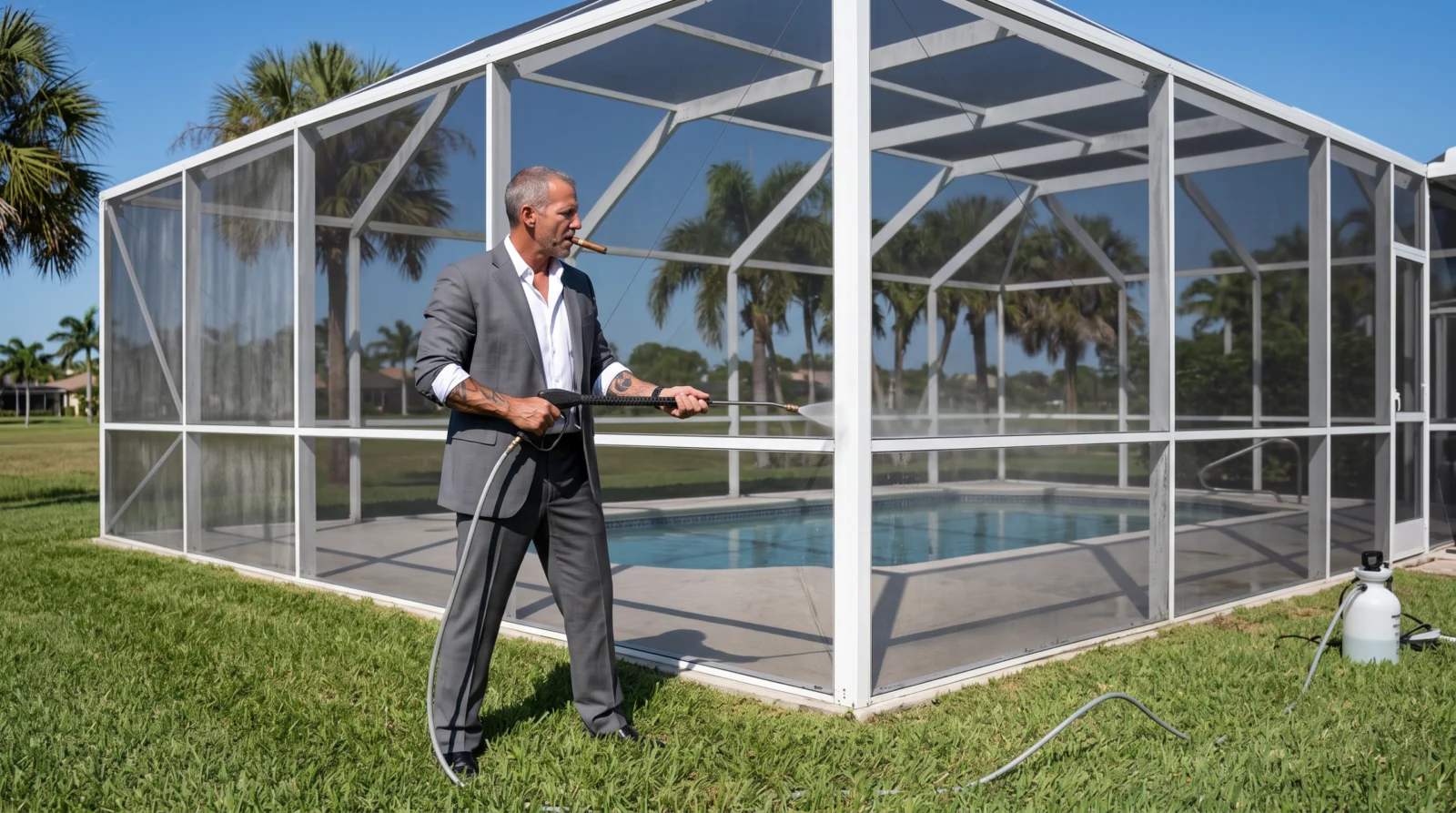
Lanai Screen Cleaning:
What Pros Do Differently
Cleaning lanai screens wrong tears the mesh, bends the frame, and leaves streaks. Here is how professionals clean Naples pool cages and screen enclosures without damage — and why the pressure matters more than the chemical.
Tears Screens
Prevents Tears
Prevents Streaks
Screen Tears from High Pressure
Standard pressure washing PSI (1,500–3,500) tears pool cage screen mesh on contact. Naples screens are typically 18×14 or 20×20 mesh — fine enough to tear from direct high-pressure spray at close range. Even a brief burst with a standard pressure nozzle can create a tear that requires panel replacement. The correct pressure for screen cleaning is 100–300 PSI maximum with a wide fan tip maintained at distance.
Frame Bending at Joints
Pool cage aluminum frame is light-gauge material. High-pressure water aimed at frame joints, especially the vertical spline channels that hold the screen, can deform the aluminum. Once bent, a frame joint is visible, catches debris, and may not re-screen cleanly. Direct high-pressure at frame connections is the cause.
Streaking From Wrong Sequence
Cleaning screens before cleaning the cage frame produces streaks — algae and mold rinsed from the frame flows down across the already-clean screens. The correct sequence is always frame first (top to bottom), then screens. Within each screen panel, rinse from the top down to prevent streaks from above settling on cleaned sections below.
Apply Solution to Frame and Screen at Low Pressure
A diluted sodium hypochlorite and surfactant solution is applied to the entire enclosure at soft wash pressure (50–150 PSI). The surfactant helps the solution cling to both the aluminum frame and the screen mesh during dwell time. The chemistry does the work — not the pressure. Dwell time of 5–10 minutes allows algae and mold to die and detach from both surfaces.
Rinse Frame First, Top to Bottom
Rinse the cage frame (horizontal and vertical members, corner joints, door frames, ridge) from top to bottom before touching the screens. Any residue from the frame drips down onto screens that have not yet been rinsed, which is fine — they will be cleaned next. Doing this in reverse order produces streaks.
Rinse Screens Inside-Out at Distance
Rinse screens from the inside of the enclosure outward at 100–300 PSI maximum with a wide fan tip. The inside-out direction pushes debris through the mesh in the direction it entered naturally (from the outside), which reduces resistance and tearing risk. Maintain 18–24 inches minimum distance from the screen surface. Never aim the wand perpendicular at the screen from close range.
Final Outside Rinse at Low Angle
A final rinse from outside the enclosure at a low angle removes any remaining surface residue. At this point the screens are clean and the frame is clean — the final rinse is completion, not cleaning. Avoid any high-pressure concentrated stream at this stage.
Not every panel on a Naples cage is the same fabric, and the differences change how carefully each one has to be handled. Phifer, one of the large screen makers, sells standard 18×14 fiberglass mesh, a finer 20×20 no-see-um mesh that it says keeps out most tiny bugs while still letting breezes through, and tougher products such as PetScreen, which it describes as able to withstand clawing and pawing and as tear and puncture resistant.
Many enclosures also use a solid-looking kick panel or privacy screen along the bottom row. Phifer markets its vinyl-laminated Glas-Shield as ideal for lower enclosure panels to keep dirt and debris out, and that is exactly why those lower panels are usually the dirtiest on the cage: they take the sprinkler overspray, the mower clippings and the soil splash from every storm. We give that bottom band its own treatment and extra rinse time instead of hitting it with more pressure.
Before any solution goes on, we walk the enclosure and press lightly on each panel. A panel that bellies out or a spline that has crept out of its channel will not survive a rinse aimed at it, so those get noted and rinsed from a wider angle, or skipped and flagged for a screen repair shop.
Cage frames are typically painted or powder-coated aluminum, most often in white or bronze. SAF, a large aluminum finishing company, publishes plain guidance for cleaning painted aluminum: test any method in an inconspicuous area first, check with the original paint manufacturer for its recommended technique, do not use abrasive cleaning methods, avoid harsh acidic or alkaline cleaners because they may destroy the finish, and use solvents with care because they may stain it. It points to AAMA 609 as the reference specification.
That is why we never put a scrub pad, a wire brush or a strong acid brightener on a cage frame. When an older white frame leaves a chalky film on your hand, that film is coming off the frame finish, and it needs a gentler, tested approach rather than aggressive scrubbing. Our heavy oxidation treatment is quoted as an add-on of $75 to $150, depending on how far the chalking has gone, and we test a section on a back corner before treating the rest.
Bronze frames call for a different kind of care. Water spots stand out on the darker finish once it is clean, so the final rinse on a bronze frame has to run evenly from the top rail down with no dry patches left between passes.
Every drop rinsed off a screen roof lands somewhere, and on a pool cage that somewhere is mostly the pool and the deck. We move cushions, rugs and electronics inside or under cover, rinse the deck plants and landscape beds along the cage wall with fresh water before and after, and work the runoff toward the deck drains.
It is worth telling your pool service the date of the cleaning so the technician can check the water on the next visit. If you run an automatic cleaner or a robot, take it out of the water for the day so it is not chasing debris that comes down from the roof panels.
Screen doors get a separate look. The closer, the hinges and the bottom sweep collect sand and grit, and a door that drags on the threshold will tear its own lower panel over time. We rinse the track and tell you if the sweep or closer needs adjustment.
Pool cage pricing follows the size of the enclosure and the condition of the frame. A small cage under 800 square feet starts from $249, a standard cage from $299, and a large cage of 1,500 to 2,500 square feet from $399. Birdcage-style or outdoor-kitchen enclosures start from $499, and a pool cage plus deck floor package starts from $399.
Call 239-544-1165 with the rough footprint of your cage and whether the frame leaves chalk on your hand, and we can tell you which of those tiers applies before we arrive.
Black streaks GONE in 1 visit — and they stay gone for 2-3 years.
Soft wash chemistry kills Gloeocapsa Magma at the root, not just on the surface. No high pressure, no tile damage, no voided warranty.
Get Your Free Quote
Tell me what needs cleaning and where — I'll send a firm, no-obligation price by text or email, usually the same day.
Get My Quote →Lock in the best day for your schedule
Reserve the best time and date for your schedule and I'll follow up with your numbers. No payment to hold a spot and no obligation to keep the booking — reserve now, decide once you have the price.
We provide lanai screen and pool cage cleaning in Naples FL at the correct pressure and sequence — see all service areas.
About the Author

Owner Blane Perun started this company with a simple premise: Naples homeowners deserve a professional exterior cleaning option that doesn’t come with the inflated pricing of franchise operations and large corporate companies.