
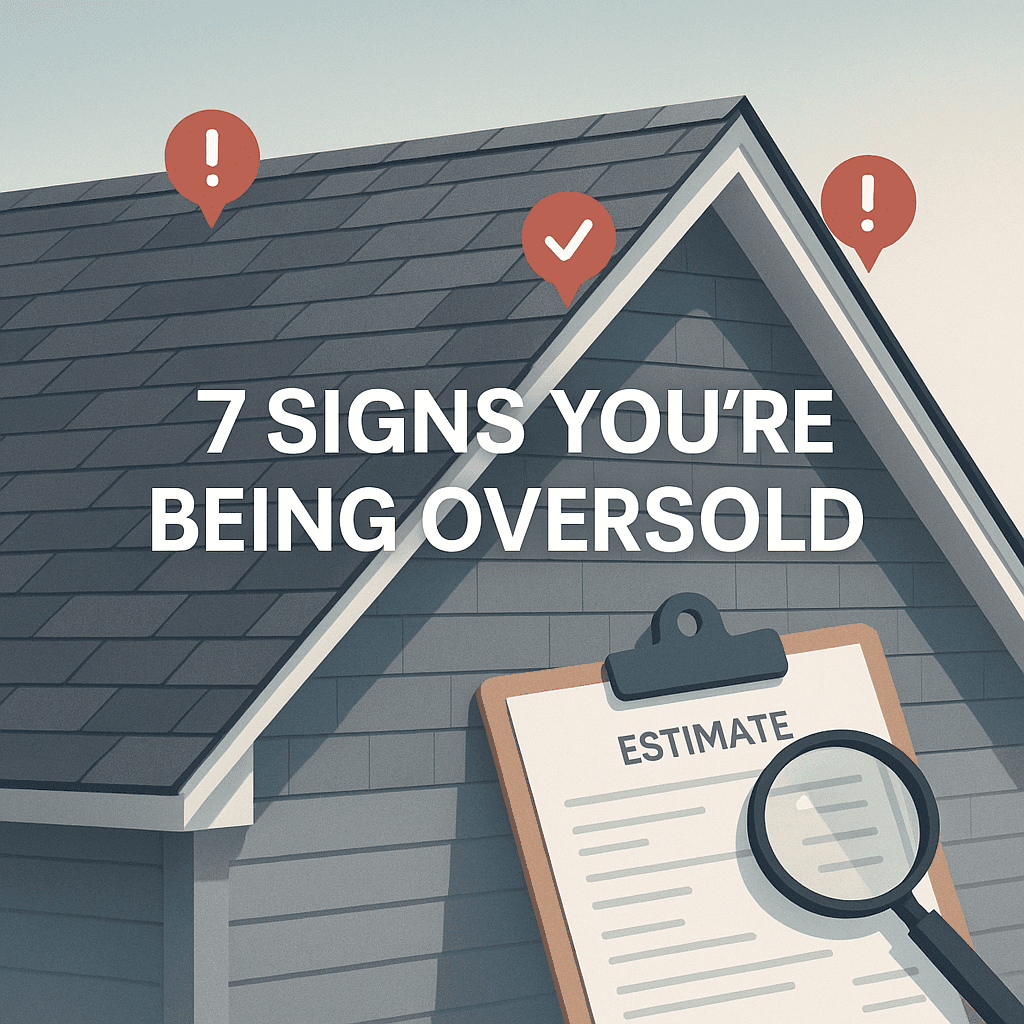
Homeownership in Southwest Florida is funny like that. You think you’re just calling someone to “take a quick look” at your shingle roof, and suddenly you’re in a kitchen table presentation with photos, financing options, and a gentle little push toward a full replacement.
Sometimes a new roof is the right call. Storm damage is real. Age is real. Bad installs are, unfortunately, very real.
But. There’s also a thing that happens a lot, especially in humid, algae friendly places like Naples. A roof looks rough from the street, someone calls it “shot,” and the whole conversation skips right past the obvious first step: figure out whether it’s actually failing, or just dirty.
This is a practical guide to spotting the difference. Here are 7 signs you might be getting oversold on your shingle roof.
1) They treat stains like structural damage
If the pitch is basically, “See these black streaks? That means the roof is done,” slow down.
Those dark streaks on asphalt shingles are often algae (Gloeocapsa magma), and in Florida it’s everywhere. It looks dramatic. It makes the roof look older than it is. But it does not automatically mean your shingles are failing.
What to ask instead:
- Are there active leaks?
- Are there soft spots in the decking?
- Is there widespread granule loss (not just normal aging)?
- Are shingles curling, cracking, or missing?
If the only “evidence” is staining and a couple zoomed in photos, you’re not looking at a roof failure diagnosis. You’re looking at a sales angle.
In a lot of cases, a professional soft wash roof cleaning can remove that algae and bring the roof back to a “normal” look without beating up the shingles. If you’re in Naples, that’s basically the day to day work of companies like Naples Pressure Washing & Roof Cleaning, since roofs here get hit hard by humidity, shade, and growth.
2) They refuse to talk about cleaning as an option
This is a big one.
If your roof is not leaking and the shingles are not obviously failing, cleaning is a reasonable part of the conversation. Not pressure washing, not blasting it. Soft washing, using the right mix and the right process.
A salesperson who immediately dismisses cleaning, or says cleaning “voids your roof,” or tries to scare you away from even getting a cleaning quote… that’s not neutral advice. That’s steering.
To be fair, some roofs should not be cleaned because they’re already too far gone. Brittle shingles can break. Severe granule loss can get worse. If a contractor explains that clearly and shows you why, cool. That’s different.
But if they won’t even evaluate cleaning as a possibility, it’s worth getting a second opinion.
3) The “inspection” is weirdly fast and strangely confident
A real evaluation takes a little time. Even if it’s not a long appointment, they should be checking the right stuff.
Things that are normal in a legit roof assessment:
- Looking at flashing areas (chimneys, vents, valleys)
- Checking for lifted or missing shingles
- Looking for exposed nails
- Asking about leak history
- Checking attic signs (staining, mold, damp insulation) if there’s an actual leak claim
- Noting ventilation issues (which can shorten shingle life)
If someone stands in your driveway for 90 seconds, squints at the roof, then tells you with absolute certainty you need a full replacement… yeah. That’s not a careful diagnosis. That’s a script.
And if they push you to sign “today” because of a “special price,” even more so.
4) They show you dramatic photos, but they’re not clearly your roof
This happens more than people think.
You’ll get a little slideshow. Rotten decking. Torn underlayment. Moldy plywood. A nail pop from hell. And then the conclusion is, “That’s what’s happening up there.”
Maybe. But also maybe those photos are from another job. Or another neighborhood. Or another year.
If they’re using photos as evidence, you should be able to confirm:
- The photos are of your roof
- The location on the roof is identified (front slope, rear, valley, etc.)
- The issue shown matches the symptoms you’re experiencing (leak location, staining inside, etc.)
Otherwise you’re just watching a fear reel.
A good contractor will mark up the images, explain what you’re looking at, and tie it to an actual problem. Not just vibes.
5) They call normal aging “storm damage,” without proof
Florida gets storms. Roofers chase storms. That’s not a conspiracy, it’s just business.
But there’s a line between legitimate storm damage and “we can probably get insurance to pay for this.”
If someone is telling you the roof is storm damaged, ask for specifics:
- Where is the damage located?
- How many shingles are impacted?
- What type of damage is it (creases, tears, missing tabs)?
- Is the damage consistent with a specific date of loss?
- Can they document it clearly for an adjuster?
Also, be careful with vague language like “hail damage” in a place where hail is not exactly routine. Not impossible, but it needs to be real and verifiable.
Normal wear and tear, algae staining, and minor granule shedding can get framed as “storm damage” if the goal is to sell you a claim, not to solve your roof problem.
6) They push replacement when the issue is actually ventilation or maintenance
Sometimes the roof looks worse because the attic is cooking it from below. Poor ventilation can trap heat and moisture, which can shorten shingle life and cause curling or premature aging.
That doesn’t always mean “replace everything.” It might mean:
- Fix intake and exhaust ventilation balance
- Address blocked soffits
- Add ridge vents (if appropriate)
- Improve insulation and airflow
And on the outside, it might mean the roof is simply overdue for maintenance. In Florida, organic growth builds up fast. If you let it go long enough, it can hold moisture and accelerate deterioration.
So here’s the oversell tell: they jump straight to replacement, but they don’t mention ventilation, they don’t ask about attic conditions, and they don’t talk about a maintenance plan at all.
Even if you do end up replacing the roof, you still want the underlying cause handled so you’re not repeating the same cycle.
7) They use a “one size fits all” lifespan to corner you
You’ll hear things like:
- “These shingles only last 15 years.”
- “In Florida, you’re lucky to get 10 to 12 years.”
- “Once it looks like this, it’s done.”
There’s truth mixed in there. Florida conditions are harsh. Sun, heat, humidity, salt air, storms. Sure.
But shingle lifespan isn’t a single number. It depends on:
- Shingle quality and rating
- Installation quality
- Ventilation
- Roof pitch and orientation (south facing slopes get cooked)
- Tree cover and shade (more algae growth)
- Maintenance history
- Whether it’s been improperly pressure washed before
A contractor who uses a blanket lifespan statement as the main argument is trying to simplify you into a yes.
A better approach is: “Here’s what we’re seeing. Here’s what’s normal. Here’s what’s not. Here are your options, with pros and cons.”
That’s what you want.

Quick reality check: when a new shingle roof actually makes sense
Just to keep this honest. Sometimes the roof really is done. Replacement may be the smart move when you have:
- Active leaks that trace to widespread roof failure
- Large areas of missing, cracked, or brittle shingles
- Severe granule loss with exposed asphalt
- Sagging decking or soft spots
- Repeated repairs that are no longer holding
- Major storm damage documented across multiple slopes
- A roof at end of life plus insurance or resale timing that makes replacement practical
If that’s your situation, you don’t need a “cleaning.” You need a plan.
But if the roof is mainly ugly, streaked, or greened over, and nobody has proven real failure, that’s where overselling tends to creep in.
What to do if you suspect you’re being oversold
A simple approach, nothing fancy.
- Ask for the exact failure reason. Not “it’s old.” Not “it looks bad.” What’s failing.
- Ask for photos that clearly show your roof. With locations.
- Get a second opinion from a roofer who does repairs, not only replacements.
- Get a cleaning evaluation. Especially if the “problem” is staining or growth.
If you’re in Naples, Bonita Springs, or Marco Island and you want to rule out the obvious algae and grime factor first, you can get a soft wash quote from Naples Pressure Washing & Roof Cleaning. A proper roof cleaning won’t magically fix broken shingles, but it can absolutely stop you from replacing a roof that was just… dirty.
One last thing
Overselling works because roofs are stressful. Most people don’t climb up there, and you kind of have to trust whoever shows up with a ladder and a confident voice.
So just slow the timeline down a little. Ask for proof. Ask for options. And remember that “looks terrible” and “is failing” are not the same sentence, even if they sometimes overlap.
FAQs (Frequently Asked Questions)
How can I tell if the black streaks on my shingle roof are a sign of damage or just algae?
Black streaks on asphalt shingles in Florida are often caused by algae called Gloeocapsa magma, which is common due to the humid climate. These streaks make the roof look older but don’t necessarily mean the shingles are failing. To determine if there’s actual damage, check for active leaks, soft spots in the decking, widespread granule loss, or shingles that are curling, cracking, or missing. If only staining is present without these issues, it’s likely just algae and can often be cleaned professionally.
Is roof cleaning a safe and effective alternative to full roof replacement?
Yes, roof cleaning—specifically soft washing using the right mix and process—is a reasonable option if your roof isn’t leaking and shingles aren’t obviously failing. Soft washing can remove algae and restore your roof’s appearance without damaging shingles. However, some roofs with brittle shingles or severe granule loss might not be good candidates for cleaning. Always get a thorough evaluation from a trustworthy contractor who will discuss cleaning as an option rather than dismissing it outright.
What should I expect during a legitimate roof inspection?
A proper roof inspection should take some time and include checking flashing areas (like chimneys and vents), inspecting for lifted or missing shingles, looking for exposed nails, asking about any leak history, examining attic signs such as staining or mold if leaks are suspected, and noting ventilation issues that could shorten shingle life. Be cautious if an inspector spends less than a couple of minutes before confidently recommending a full replacement or pressures you to sign immediately.
How can I verify that photos shown during a roof assessment actually represent my roof’s condition?
If a contractor shows dramatic photos as evidence of damage, ask them to confirm that these images are from your specific roof. They should identify the exact location on your roof (front slope, rear, valley) where the issue exists and explain how the problem matches any symptoms you’re experiencing like leaks or interior staining. Reliable contractors will mark up photos clearly and provide explanations tied directly to your home’s condition rather than showing generic or unrelated images.
What questions should I ask if a roofer claims my damage is caused by storms?
Storm damage claims should be backed by clear evidence. Ask where exactly the damage is located on your roof, how many shingles are affected, what type of damage it is (creases, tears, missing tabs), whether the damage corresponds to a specific storm date, and if they can document everything properly for insurance adjusters. This helps differentiate genuine storm-related issues from normal aging or wear being misrepresented as storm damage.
Why might some roofing contractors discourage cleaning and push for full replacements instead?
Some contractors may steer you away from cleaning because it doesn’t generate as much profit as full replacements do. Additionally, they might claim that cleaning voids warranties or damages shingles without providing clear evidence. While some roofs truly need replacement due to severe deterioration, ethical contractors will evaluate cleaning feasibility honestly and explain their reasoning clearly. If cleaning is dismissed outright without evaluation, it’s wise to seek a second opinion.