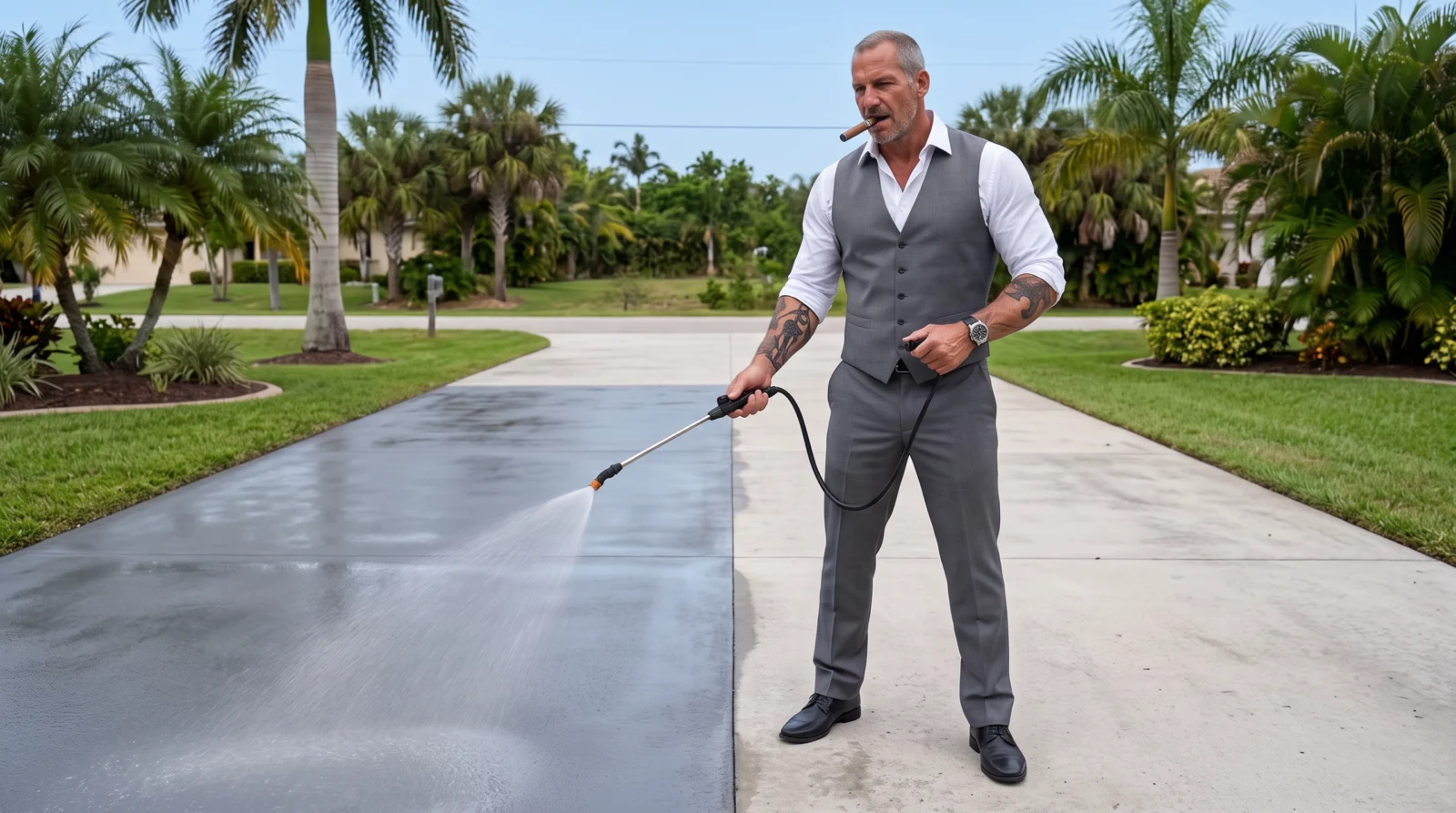
Concrete Driveway Sealing Naples FL —
Clean, Treat & Seal
We deep clean poured concrete driveways, walks and stamped patios, treat rust and mildew, and apply a sealer chosen for how the slab is finished and used. Cleaning and every sealing job are quoted after we see the concrete.
📞 Call for a Free Quote — 239-544-1165Part of our Paver Sealing service →
Cleaning
or Acrylic
Competition
& Insured
Poured concrete looks solid, but it is full of tiny capillary pores. In Naples those pores pull in rainwater, irrigation overspray, tire grime and the spores that turn a light gray driveway dark in a single summer. Once mildew and algae root into the surface, a plain rinse only lightens them for a few weeks.
Irrigation is the second problem. Many Collier and Lee County homes water from wells, and that water carries iron. Every time the sprinklers hit the slab, they leave orange rings and streaks that bond to the cement paste. Fertilizer granules that land on wet concrete leave the same rust-colored spots.
A sealer slows all of that down. It fills or lines the pores so water beads and runs off, stains sit on top long enough to be rinsed away, and the next cleaning takes less effort. On stamped and colored concrete it also protects the color layer from UV fade and holds the release-agent tones that give the pattern its depth.
Sealing only works on clean, dry concrete. If mildew, rust or oil is still in the surface, the sealer locks it in. That is why every sealing job we do starts with a full cleaning and spot treatment, and why we schedule the sealer coat only after the slab has had time to dry out in our humidity.

Brick pavers have their own page under Paver Sealing. This page covers one-piece poured slabs: broom-finish driveways, sidewalks, stamped patios and garage aprons.

There are two families of concrete sealer. Penetrating sealers, usually silane or siloxane blends, soak into the slab and react inside the pores. They leave no visible film, keep the original look, stay breathable and do not get slippery. They are the usual choice for plain broom-finish driveways.
Film-forming acrylic sealers sit on top. They add color depth and a satin or gloss sheen, which is why owners of stamped and stained concrete like them. The tradeoff is upkeep. A film wears in tire paths, can turn milky if moisture is trapped underneath, and needs a recoat every few years.
We test the slab first. A few drops of water tell us whether an old sealer is still present, and a small test area shows how a new product will look before we commit the whole driveway. If an old acrylic coat is peeling or cloudy, it has to be stripped before anything new goes on.
| Sealer type | Look | Best for | Typical recoat |
|---|---|---|---|
| Silane / siloxane penetrating | No change, natural matte | Broom-finish driveways and walks | Several years |
| Water-based acrylic | Light satin, low odor | Shaded slabs, lanai edges | About 2–3 years |
| Solvent-based acrylic | Deeper color, semi-gloss | Stamped and stained concrete | About 2–3 years |
| Acrylic with anti-slip grit | Satin with fine texture | Sloped drives, pool-side concrete | About 2–3 years |
Standard Driveways
The most common slab in Naples subdivisions. A penetrating sealer keeps it from soaking up rain and mildew without changing the look.
Patterned Concrete
Stamped patios and entry walks lose color to sun first. An acrylic sealer restores depth and protects the release-agent tones.
Pebble Finish
Loose or dull stones can be locked in and brightened. We clean between the stones with low pressure before sealing.
High-Wear Areas
The first few feet inside and outside the garage take the most tire traffic and oil. We pre-treat drips before any sealer goes on.
Cleaning is priced from our standard driveway rate. Sealing depends on square footage, the sealer you choose and whether an old coating has to come off, so we price it after a short look at the slab.
We are consistently 15–30% less than the competition with no franchise fees. The quote lists the sealer by name so you know what is going on your driveway.
Inspect and test
We check for old sealer, cracks, rust, oil and how much shade the slab gets, then agree on the sealer type with you.
Pre-treat stains
Rust from wells and fertilizer gets a rust remover. Oil gets a degreaser. Mildew gets a soft wash solution that kills it at the root.
Surface clean
A rotary surface cleaner gives an even clean with no wand stripes. Edges and expansion joints are detailed by hand.
Dry time
Concrete holds water. We let it dry fully before sealing, which in Naples humidity can mean coming back on a second day.
Apply sealer
Sealer goes on with a low-pressure sprayer and back-roller for an even coat with no puddles. Joints and edges are cut in by brush.
Cure and record
We tape off the driveway and tell you when foot and car traffic can return. You get a written service record with the date, surfaces and products.
We provide concrete driveway sealing in Naples FL and throughout Southwest Florida:
Penetrating sealers come with rules, and the product data sheet is where they live. Take PROSOCO’s PR Concrete Silane WB 20, a water-based silane made for concrete that carries vehicle traffic. Its sheet says new concrete should cure a minimum of 14 to 28 days before application, so a driveway poured during a remodel or a garage addition waits several weeks before it can be treated. The same sheet lists coverage of 100 to 175 square feet per gallon on concrete and says the figure varies with the slab’s porosity and texture, which is one reason a dense trowelled apron and an open broom finish never take the same amount of product.
Weather limits matter more here than the label suggests. PROSOCO calls for surface and air temperatures above 40°F and below 95°F, warns against windy days, and advises working early and in shaded areas when it is warm. A west-facing Naples driveway in August can climb past that ceiling at the surface well before noon, so summer sealing starts at first light and follows the shade line. The treated slab also has to stay clear of rain, foot traffic and cars for at least four hours, and during the rainy season that dry window decides the day more than anything else on the schedule.
The sheet is blunt about what is already on the slab. Previous sealers and curing compounds have to come off because they can keep the silane from penetrating, and acid-stained concrete must be thoroughly neutralized and rinsed first. It also notes that the product, though it forms no film, may darken or enhance some surfaces, and it tells applicators to test a small area of each surface. Overspray is the last concern: the maker says to protect people, vehicles and untreated surfaces from spray and wind drift, and to remove dried residue from window glass within three to five days. Where a driveway runs up to sliding doors or a garage door with glass panels, those are masked before the first pass.
Get a firm price for Concrete Sealing, usually the same day.
Tell us what needs cleaning and where. We review your photos, send a written price by text or email, and handle gate and building access.
Get Your Free Quote
Tell me what needs cleaning and where — I'll send a firm, no-obligation price by text or email, usually the same day.
Get My Quote →Lock in the best day for your schedule
Reserve the best time and date for your schedule and I'll follow up with your numbers. No payment to hold a spot and no obligation to keep the booking — reserve now, decide once you have the price.
About the Author

Owner Blane Perun started this company with a simple premise: Naples homeowners deserve a professional exterior cleaning option that doesn’t come with the inflated pricing of franchise operations and large corporate companies.