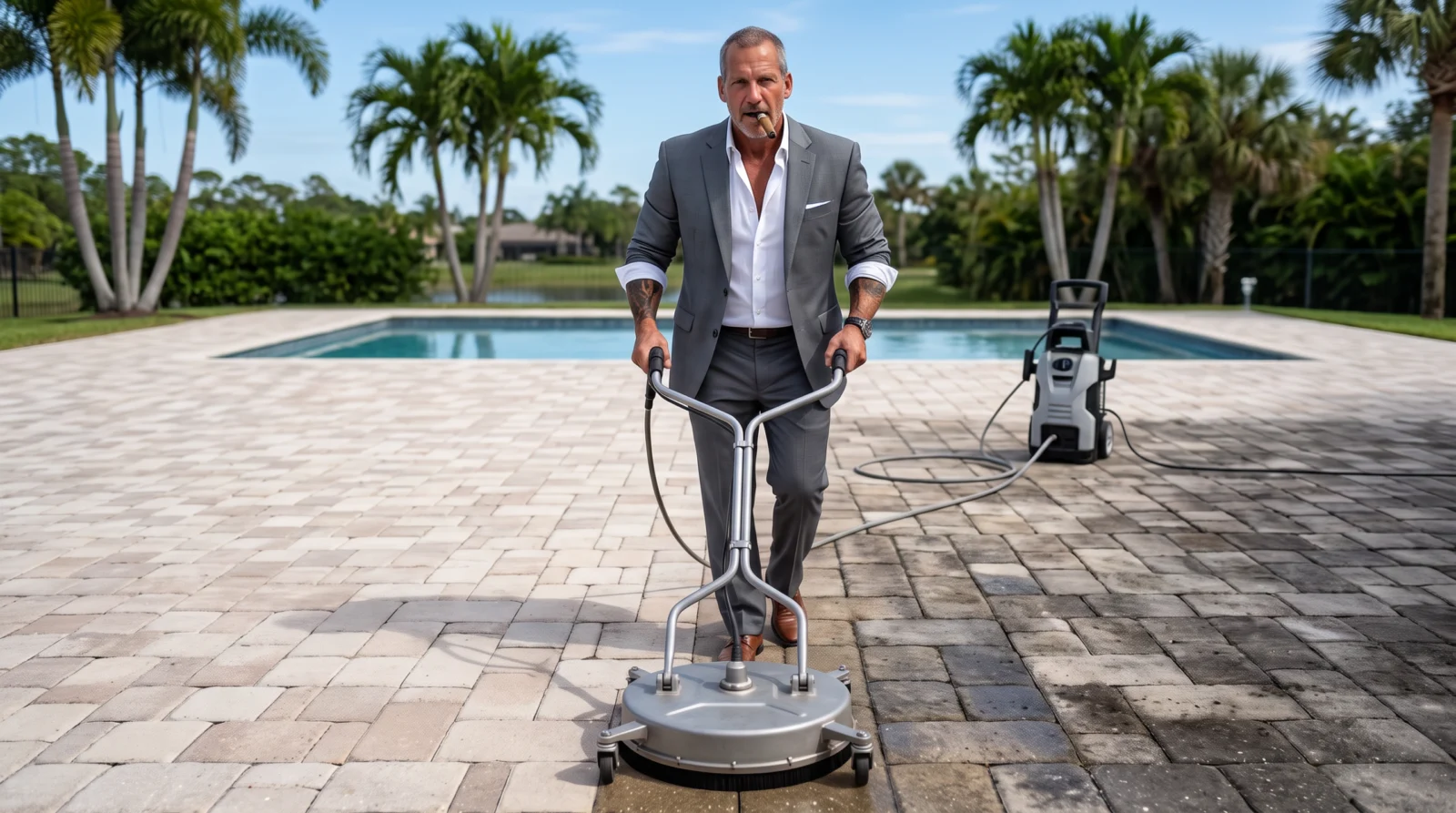
How To Clean Pool Deck
Pavers in Naples FL
A complete Naples guide to cleaning pool deck pavers safely — why reduced pressure protects the joint sand, how algae and slip hazards are removed, and how we price it.
📞 Call for a Free Quote — 239-544-1165Pool Deck Pavers
Protects Joint Sand
Competition
Quote
Pool deck pavers in Naples take a lot of abuse — constant moisture from the pool, sun, pool chemicals, and Florida humidity all combine to grow algae and mildew across the surface and in the joints. Cleaning them means removing that growth without damaging the paver installation.
The key rule for pavers is reduced pressure. Pool deck pavers are set with joint sand between them, and that sand is what locks the pavers in place. Full pressure blasts the joint sand out — leaving loose, shifting pavers that then need to be re-sanded.
The correct method uses a soft wash cleaning solution to break down the algae and mildew, then a reduced-pressure clean and rinse. The solution does the work, so the pressure only needs to be high enough to clean — not high enough to disturb the joints.
There is also a safety angle specific to pool decks: algae growth makes paver surfaces slick when wet. Cleaning it off removes a real slip hazard right next to the pool — which is exactly where you do not want one.

Pool deck pavers must be cleaned at reduced pressure. Full pressure blasts the joint sand out from between the pavers — leaving them loose and requiring re-sanding. A soft wash solution does the cleaning work instead.

1. Guard the pool first. Skimmer mouths, return jets and the equipment pad are covered, nearby plants get a soaking of plain water, and the deck’s fall is used to send rinse water away from the pool wherever possible.
2. Pre-treat the algae and mildew. A soft wash cleaning solution is applied to the pavers, breaking down the biological growth on the surface and in the joints at the root.
3. Lift it gently. A low setting and steady, lapped passes take the loosened growth off the paver faces while the sand in the joints stays put.
4. Final rinse. The deck is rinsed clean, carrying away the dead growth and solution residue, leaving an even, finished surface — with the joint sand intact.
If the joint sand is already low or washing out before cleaning, we can advise on re-sanding — but the goal of the clean itself is always to protect the joints, not disturb them.
Algae & Mildew
Constant pool moisture and Florida humidity grow algae and mildew across the pavers and in the joints. A soft wash solution breaks it down at the root.
Slick Green Growth
Algae makes paver surfaces slick when wet — a real slip hazard right at the pool’s edge. Cleaning removes it and restores safe footing.
Calcium & Mineral Deposits
Pool water splash-out can leave calcium and mineral staining on the pavers around the waterline. These are treated as part of the cleaning.
Embedded Dirt & Debris
Dirt, pollen, and organic debris work into the paver joints. The cleaning clears the surface and joints without disturbing the locking sand.
Pool decks are priced from a free online quote built on the deck’s area and how heavy the growth is. The gentler, slower method pavers need is part of that number. Common Naples starting points:
We are consistently 15–30% less than the competition. No franchise fees, no corporate overhead. Call us after getting other quotes — we will beat them. Call 239-544-1165 for a free online quote.

“I started this company to give Naples homeowners a professional option that doesn’t cost a fortune. We do the same quality work as anyone in this market — for less. That’s my promise.” — Blane Perun
15–30% Less Than Competition
No franchise fees, no corporate overhead. Blane runs every job personally.
Florida Licensed Contractor
Fully licensed and insured. COI available on request.
Pre-Approved Access
Pre-registered with most major Naples gated communities. Gate coordination handled directly.
We provide pool deck paver cleaning in Naples FL and throughout Southwest Florida:
On a pool that runs on a salt chlorine generator, owners often notice a pale crust forming where splash-out dries on the deck. The Concrete Masonry and Hardscapes Association addressed this directly in a May 2025 article by engineer Robert Bowers. He writes that the white deposits can dull or fade the look of the paver surface over time, but that the effect is mostly cosmetic and similar to efflorescence, and that there is no chemical reaction between the salt and the oxide pigments used in quality pavers.
The article’s one structural warning concerns climates with freezing winters, where salt combined with freezing and thawing can accelerate concrete deterioration, which is not a Southwest Florida concern. Its practical advice is reassuring: often a simple rinse with warm, fresh water is enough to restore the pavers’ appearance, and salt buildup by itself does not mean the deck is damaged. A hose-down of the splash zone after a busy pool weekend goes a long way.
Bowers is far more cautious about acid than about salt. He writes that acids can deteriorate the concrete itself and permanently affect the color, and that acid spills, such as from acidic pool cleaners, cause far more damage than saltwater. That matters on a Naples lanai where muriatic acid or pH reducer is often stored a few feet from the deck and poured into the pool on a regular schedule.
The habit that follows is simple: dilute and pour pool chemicals over the water or the equipment pad, never by setting the jug down on the pavers, and keep containers on a tray rather than the deck. It also explains why we do not reach for strong acids to strip deposits off pavers. Any treatment for waterline calcium has to be one made for concrete pavers, tested on a single paver first.
Another common complaint is the band of white or grey residue that forms where pool water splashes and dries. Mutual Materials, a paver manufacturer, describes efflorescence as a white haze that can appear on pavers some time after installation and treats it as an appearance issue, not a structural one. It recommends cleaners made for concrete pavers and warns that careless or improper cleaning can damage and discolor the paver surface.
Put that together with the industry’s warning about acids and the approach is clear. Try fresh water first, since salt residue often rinses away. Move to a product labeled for concrete pavers only where fresh water fails, follow its dilution and dwell instructions exactly, and rinse thoroughly so nothing is left to dry on the deck in the afternoon sun.
A pool deck is the one paver surface where the finish has to be judged barefoot and wet. The CMHA technical note on cleaning and sealing interlocking pavers says sealers reduce the intrusion of water, stains, oils and dirt into the paver surface, that generally only one coat is required, and that sealers should not be over-applied to the point where the surface becomes slippery once cured. Bowers’ saltwater article adds that a sealer can enhance paver color and make surface stains easier to remove.
That is why our pool deck sealing is sold as a slip-resistant service, and why a thin, even coat matters more on a pool deck than a high-gloss look. The same CMHA note asks for the cleaned surface to be completely dry before most sealers go on and for traffic to stay off until the sealer has dried, typically 24 hours, which for a pool deck means planning a day without swimmers walking out of the water onto it.
Black streaks GONE in 1 visit — and they stay gone for 2-3 years.
Soft wash chemistry kills Gloeocapsa Magma at the root, not just on the surface. No high pressure, no tile damage, no voided warranty.
Get Your Free Quote
Tell me what needs cleaning and where — I'll send a firm, no-obligation price by text or email, usually the same day.
Get My Quote →Lock in the best day for your schedule
Reserve the best time and date for your schedule and I'll follow up with your numbers. No payment to hold a spot and no obligation to keep the booking — reserve now, decide once you have the price.
About the Author

Owner Blane Perun started this company with a simple premise: Naples homeowners deserve a professional exterior cleaning option that doesn’t come with the inflated pricing of franchise operations and large corporate companies.
