How Often Do Pavers
Need Re-Sanding in Naples FL?
A complete Naples guide to paver re-sanding frequency — how often joint sand actually needs replacing, what speeds up washout, and what re-sanding costs. Most Naples pavers: every 2–4 years.
📞 Call for a Free Quote — 239-544-1165Typical Naples Pavers
Paver Sanding
Competition
Quote
For most Naples paver installations, joint sand needs replacing every 2 to 4 years — but the real answer depends entirely on the conditions the pavers face and what kind of sand was used last time.
Polymeric sand lasts longer — often toward the 3–4 year end or beyond — because the hardened binders resist washout. Regular joint sand washes out faster, sometimes needing attention every 1–2 years in Naples’ heavy rain.
Conditions matter just as much. Pavers that get heavy rain runoff, frequent pressure washing, or constant traffic lose joint sand faster. A low-traffic patio holds sand far longer than a daily-use driveway or a pool deck that gets pressure washed often.
The simplest rule: if you can see the joints are low, the pavers are starting to shift, or weeds are coming up in the gaps, it is time to re-sand. Catching it early keeps the installation locked and stops the pavers from moving.
If the joints look low, the pavers are starting to shift, or weeds are coming up in the gaps, it is time to re-sand. Catching it early keeps the installation locked and stops the pavers from moving.
Heavy rain and runoff. Naples gets intense, frequent rain. Pavers in the path of roof runoff or natural drainage lose joint sand fastest as water washes it out of the gaps.
Frequent pressure washing. Pressure washing pavers — especially at too-high pressure — blasts joint sand out. The more often pavers are cleaned, the more often they need re-sanding.
Traffic. A daily-use driveway or a busy walkway works the joint sand loose over time. Low-traffic patios hold their sand far longer.
The type of sand used. Regular joint sand washes out faster than polymeric sand. If the last re-sanding used regular sand, expect a shorter interval before the next one.
Slope and drainage. Pavers on a slope or in a low spot where water collects and flows lose joint sand faster than flat, well-drained installations.
Regular Sand, High Wear
Pavers sanded with regular joint sand that also get heavy rain runoff, frequent pressure washing, or constant traffic lose sand fast and need attention sooner.
Typical Naples Pavers
Most Naples paver installations — average wear, average conditions — fall in the 2–4 year window. This is the standard expectation.
Polymeric Sand, Low Wear
Pavers sanded with polymeric sand on a low-traffic, well-drained patio can go toward the 3–4 year end or beyond between re-sandings.
Visible Joint Loss
Regardless of the calendar — if joints are visibly low, pavers are shifting, or weeds are coming up, re-sand. Visible joint loss is the real signal.
All paver re-sanding pricing is based on a free online quote — square footage, joint condition, and whether cleaning is needed first determine the final price. We use polymeric sand to extend the interval between re-sandings. These are honest starting ranges for Naples:
We are consistently 15–30% less than the competition. No franchise fees, no corporate overhead. Call us after getting other quotes — we will beat them. Call 239-544-1165 for a free online quote.

“I started this company to give Naples homeowners a professional option that doesn’t cost a fortune. We do the same quality work as anyone in this market — for less. That’s my promise.” — Blane Perun
15–30% Less Than Competition
No franchise fees, no corporate overhead. Blane runs every job personally.
Florida Licensed Contractor
Fully licensed and insured. COI available on request.
Pre-Approved Access
Pre-registered with most major Naples gated communities. Gate coordination handled directly.
We provide paver re-sanding in Naples FL and throughout Southwest Florida:
You do not need a calendar to know when your joints are due; the pavers will tell you. Take a flat-blade screwdriver or an old key and press it into the joints in five places: the driveway apron where tires turn, the strip under each downspout, the band along the pool coping, the lowest corner where water collects, and one spot in the middle of a low-traffic patio as your baseline.
If the blade sinks easily well below the paver edge in the busy spots but not in the baseline spot, the sand has washed or worn out where the stress is. Other tell-tale signs: small mounds of fine sand next to joints from ant activity, pavers that click or rock when you step on a corner, weeds rooted along the joint line, and a dark band of algae where water now sits in an open gap.
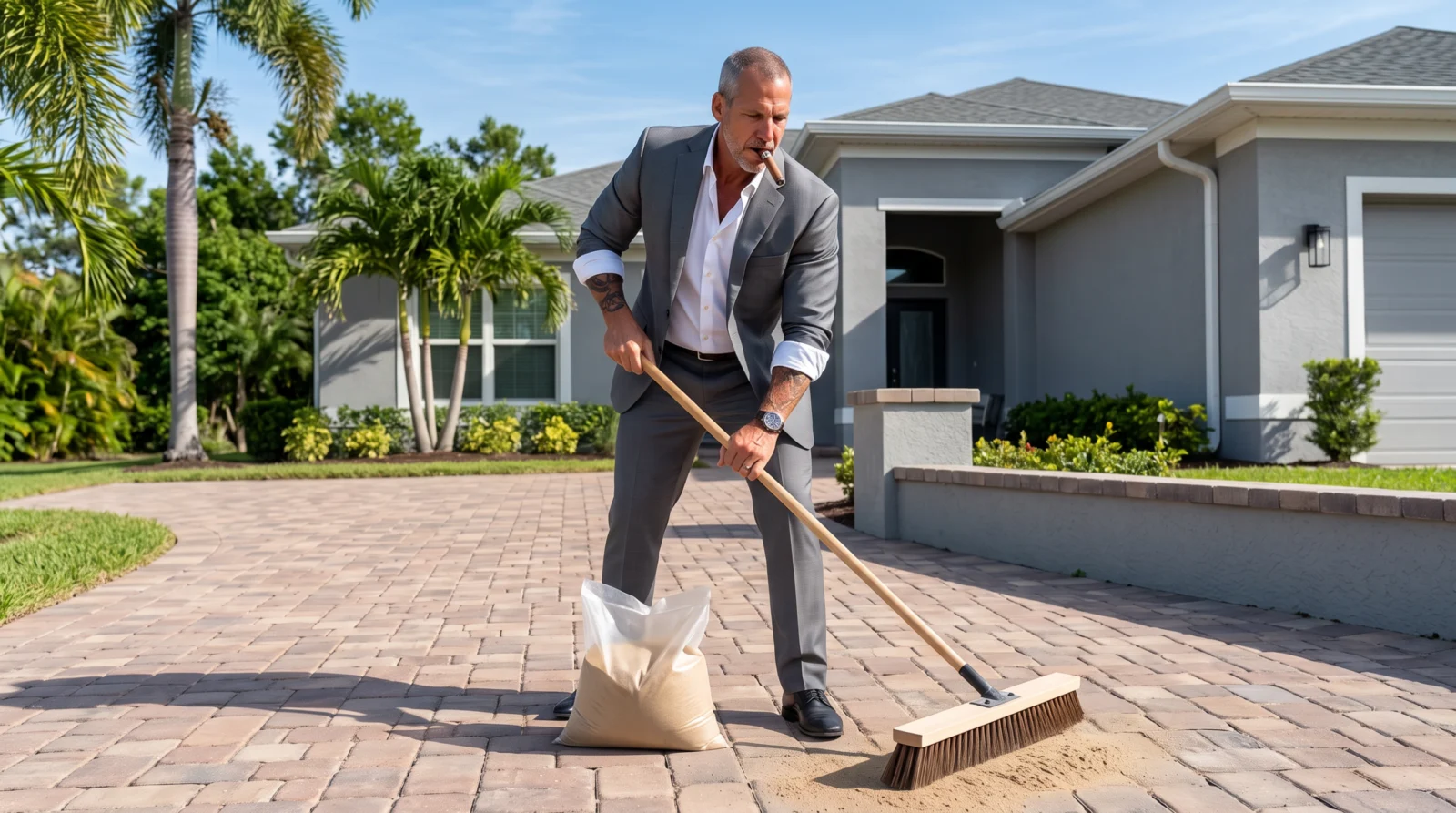
Sweeping a bag of sand over the surface is a top-dress, not a re-sand. Alliance Gator’s installation instructions for Gator Supersand G2 on existing pavers call for the joints to be cleaned out to a minimum of 1 1/2 inches (38 mm) deep, with the finished sand level at least 1/8 inch below the paver surface or chamfer.
1. Clean and dry. The same instructions say not to apply if the paver surface or the joints are damp or wet. In Naples humidity, that is the step that most often decides the schedule: pavers washed in the morning may need the rest of a sunny day, or a second visit, before sand goes down.
2. Fill and vibrate. The sand is spread with a hard-bristle broom until the joints are full, then vibrated in with a plate compactor fitted with a rubber pad, working in several directions and repeating until the joints stay full.
3. Sweep twice. Excess is swept off first with a hard-bristle broom, then a soft one, so the paver faces are left clean before any water touches them.
4. Activate. Alliance Gator specifies a hose nozzle on the shower setting, starting at the lowest point, for a minimum of 30 seconds per 30 sq. ft. or until water starts to sit on the joints, without letting the surface dry out mid-process. Supersand G2 is listed as rain safe 15 minutes after water activation, which suits Southwest Florida’s afternoon storms.
Polymeric sands are rated for specific joint widths, so check the rating against your widest joint before buying. Alliance Gator lists Supersand G2 for joints from 1/8 inch up to 2 inches, and Gator Maxx G2 for joints up to 4 inches in traditional installations and 2 inches in overlay installations. Tumbled pavers and natural stone are often set with wider gaps than standard pavers, so measure before choosing.
Overlays, where thin pavers are laid over an existing concrete slab, also behave differently. The company lists Gator Maxx G2 as rain safe 15 minutes after activation in traditional applications but 24 hours after activation in overlay applications, so an overlay pool deck needs a longer dry-weather window after re-sanding.
Concentrated water is a common culprit in early washout. Add a downspout extension or splash block so roof runoff lands on turf or gravel instead of jetting across the same row of joints every storm. Check that irrigation heads near the pavers are not aimed along joint lines.
When the pavers are cleaned, the method matters. A rotary surface cleaner held flat at reduced pressure, followed by a gentle rinse, is gentler on the joints than a narrow wand tip run along them. If you plan to seal after a re-sand, wait the full time the sealer and sand makers call for before the sealer goes down.
Black streaks GONE in 1 visit — and they stay gone for 2-3 years.
Soft wash chemistry kills Gloeocapsa Magma at the root, not just on the surface. No high pressure, no tile damage, no voided warranty.
Get Your Free Quote
Tell me what needs cleaning and where — I'll send a firm, no-obligation price by text or email, usually the same day.
Get My Quote →Lock in the best day for your schedule
Reserve the best time and date for your schedule and I'll follow up with your numbers. No payment to hold a spot and no obligation to keep the booking — reserve now, decide once you have the price.
About the Author
Owner Blane Perun started this company with a simple premise: Naples homeowners deserve a professional exterior cleaning option that doesn’t come with the inflated pricing of franchise operations and large corporate companies.